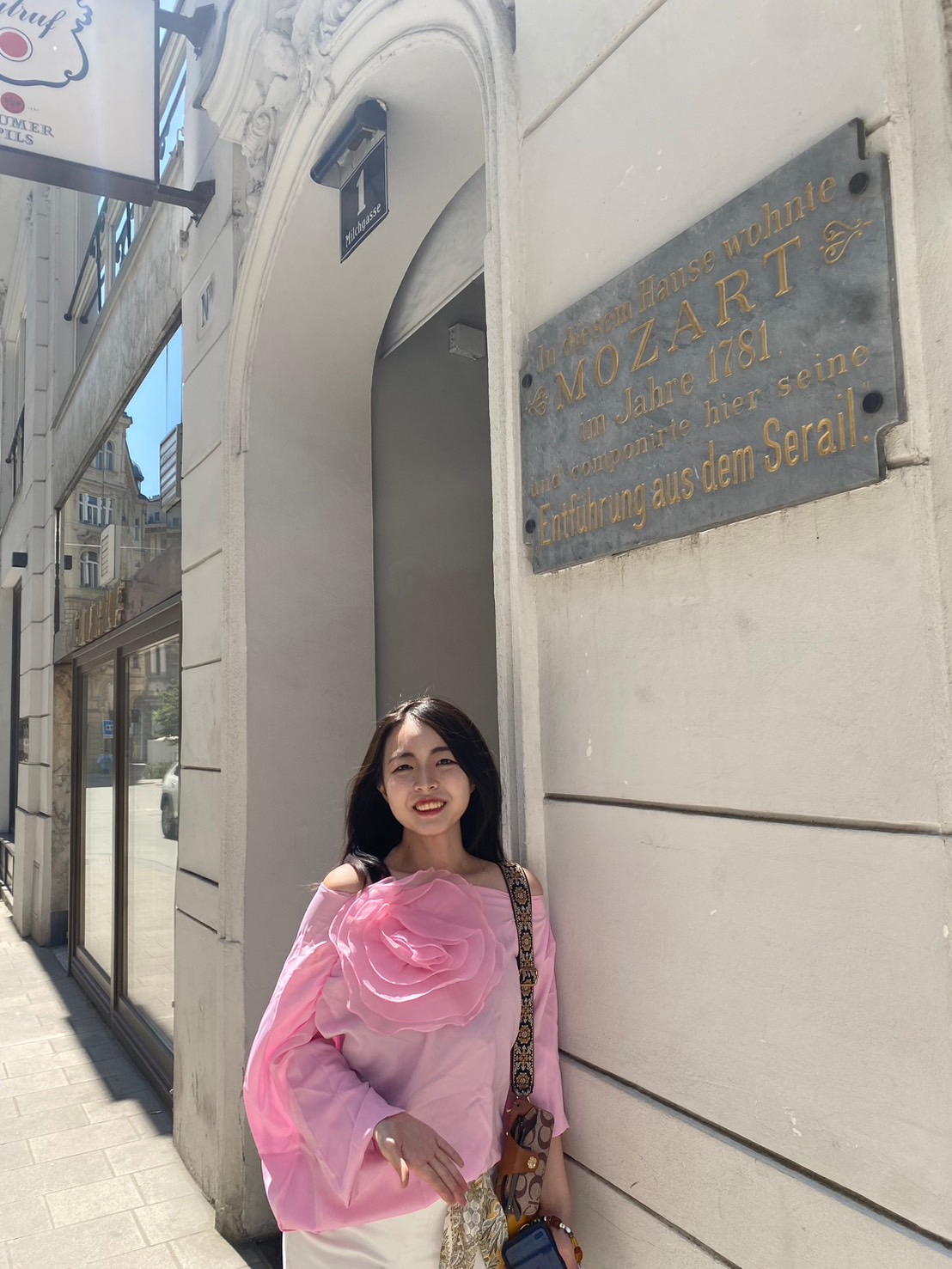
About
Cambridge Future Scholar & Researcher

Profile
Koyanagi is a researcher at the University of Cambridge, working on the governance of space, nuclear, and cyber systems — how authority is constructed, how norms break down, and what it takes to rebuild legitimacy. She is Team Leader of SGAC's 2026 Space Policy Project Team (Japan), a delegate to the JAXA International Space Education Board (2026), and a mentee in the VCDNP 2026–2027 Young Women in Non-Proliferation and Disarmament Programme — one of twenty selected worldwide.
As a Cambridge Future Scholar, she conducts supervised research under Prof. Harald Wydra on competing lunar governance frameworks. Her broader work spans dual-use space infrastructure, cross-domain escalation risk, and gaps in responsible-behaviour norms across AI, space, and cyber governance — grounded in six years of field research in post-disaster Fukushima.
Her work is forthcoming at the International Astronautical Congress 2026 (Antalya, Türkiye), with three accepted papers on dual-use neutralisation, conditional openness in lunar governance, and mythic naming in competing lunar orders.
Alongside her research, she builds two open research platforms — Faultline (strategic infrastructure risk) and Govern the Human (how AI reshapes the human subject). Both advanced to the prototyping phase of the Global Challenge to Build Trust in the Age of Generative AI — a G7-originated initiative led by the IEEE Standards Association, the OECD, and AI Commons, with UNESCO as a founding partner — among only six East Asian teams of eighty selected worldwide.
Recommendation
Risa is a brilliant young researcher, an intellectually flexible thinker, and a sophisticated writer. In twenty-two years of supervising undergraduate and graduate students at Cambridge, I have rarely encountered a student who approaches academic inquiry with such thoughtfulness, motivation, and sincerity. Most impressive of all is that she launched an exceptionally ambitious research project on her own initiative and from a critical perspective. The project addresses the future of lunar governance, and in particular the strategies and objectives of the American and Chinese lunar exploration programmes. She has already coded and analysed an enormous volume of published documents on those programmes. Her theoretical ambition covers a broad range of related concepts of legitimacy, and it is firmly underpinned by careful, comprehensive evidence-based investigation. Her very high aspirations are accompanied by quiet confidence and a modest manner. Her sociability is also extremely well developed, and she will be a wonderful presence. I recommend her with the greatest enthusiasm and without the slightest hesitation.
Education
University of Cambridge
BA, Human, Social and Political Sciences (HSPS)
The London School of Economics and Political Science (LSE)
Sep 2025 – Jun 2026BSc, Politics and International Relations
SOAS University of London
Sep 2024 – Jun 2025Foundation Degree, Social Sciences
Saïd Business School, University of Oxford
Dec 2022 – Jan 2023Certificate, AI and Digital Transformation in Government
Experience
Morgan Stanley
Aug 2026 – Present · TokyoSummer Intern (FID & Finance Sector)
Mitsubishi UFJ Research & Consulting
Aug 2026 – Present · TokyoResearch Intern
Ministry of Economy, Trade and Industry (METI)
Aug 2026 · TokyoPolicy Analysis Intern
Best award for the microeconomics policy proposal on digital trade; special award for the macroeconomics policy proposal
IBM
Aug 2026Qiskit Advocate
Effective Thesis
Summer 2026Effective Fellow (Verification and Enforcement in AI Governance)
AI Safety Camp
Selected, AI Research Incubator
Vienna Center for Disarmament and Non-Proliferation (VCDNP)
Jul 2026 – Present · Brussels/ViennaYoung Women in Non-Proliferation and Disarmament Mentee
JAXA
May 2026 – PresentInternational Space Education Board (ISEB) Student Delegate
Space Generation Advisory Council (SGAC)
Apr 2026 – Aug 2026 · TokyoSpace Policy Programme Chief, SG[Japan]
TIES
Apr 2026 – May 2026 · New DelhiYoung Research Fellow, Geopolitics of Narrative Building
Cambridge Centre for International Research (CCIR)
Sep 2025 – Jun 2026 · CambridgeResearcher, Legitimation in Lunar Governance (supervised by Prof. Harald Wydra)
UN Women, Asia and the Pacific Regional Office
May 2025 – Aug 2025 · BangkokAI Programme
AFRECOS (Association of African Economy & Development Student Committee)
Jan 2024 – Dec 2024 · TokyoPresident
Sophia University
Apr 2023 – Aug 2024 · TokyoChair, Peacebuilding Research Lab (under Prof. Daisaku Higashi); now alumni head
Independent
Jul 2019 – Aug 2024 · FukushimaField Researcher, Fukushima Post-Disaster Governance (six years of multi-site fieldwork)
Certifications
Microsoft Generative AI for Data Analysis
Professional Certificate
Google Cybersecurity Specialization
Certificate
Skills
Research
Legitimation, dual-use systems, authority architecture, strategic risk, space governance, nuclear governance, emerging technology governance, infrastructure politics.
Discourse and narrative analysis, qualitative coding, comparative political research, interpretive methods, policy framing, symbolic and mythic analysis, and research-to-interface translation.
Policy / Communication
Policy analysis, strategic writing, briefing development, narrative framing, stakeholder engagement, cross-sector communication.
Public speaking, moderation, workshop and event design, interdisciplinary collaboration, knowledge synthesis, and public-facing translation of complex political and technological issues.
Technical & Computational Methods
Platform architecture, public-facing research tool prototyping, AI workflow design, prompt engineering, OpenAI API-based feature design, Supabase-based data structuring, SQL, analytics instrumentation, event logging design, dashboard planning.
Information architecture, user-flow design, UI/UX direction, qualitative coding, discourse and narrative analysis workflows, stakeholder mapping.
Policy and infrastructure data organisation, behavioural research design, and research-to-interface translation.
Languages
Affiliations
Sophia University
Professor Daisaku Higashi Peacebuilding and International Cooperation Laboratory
Former President; current Alumni Representative
University of Tokyo
Professor Makoto Iokibe Yotsuya Reimeikai
Arts Background
Koyanagi trained in piano with Noriko Amano, Shadow Box with Ineke de Bruijn, and oil painting under Yukiko Hamano. She received an Excellence Award for poetry in 2011 and appeared as a child actor in Maribor National Opera's “Carmen.” As a teenager, she won the Excellence Award in the JYOJI-ROCK U-16 contest. Her art studies with Nobuhiko Utsumi led to a group exhibition. She has been selected for the Monster Exhibition and featured in Al-Tiba9 Contemporary Art Magazine.
Interests
Violin · Johann Sebastian Bach · Jean Sibelius · Giacomo Puccini · Giuseppe Verdi · Pyotr Ilyich Tchaikovsky · Antonín Dvořák · Igor Stravinsky · Fyodor Dostoevsky · Kabuki · Yukio Mishima · Greek Mythology · Raymond Radiguet · Rainer Maria Rilke